
Personal Development 9 min read
The 4-Hour Workweek
by Timothy Ferriss · 2007
4.5
The cult manifesto for lifestyle design: how to escape the 9-5, automate your income, live anywhere in the world, and stop deferring life until retirement.
Amazon Associate link
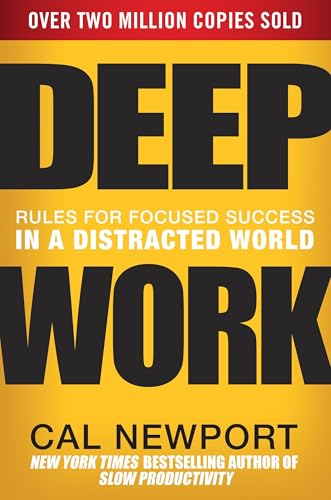
by Cal Newport · 2016
Deep work — the ability to focus without distraction on cognitively demanding tasks — is becoming simultaneously rarer and more valuable in our economy. The people who can cultivate this skill will thrive; those who can’t will fall behind. Newport doesn’t just argue why deep work matters. He provides a systematic framework for rebuilding your professional life around the practice of sustained, focused concentration.
Newport defines deep work as “professional activities performed in a state of distraction-free concentration that push your cognitive capabilities to their limit.” These efforts create new value, improve your skills, and are hard to replicate. Their opposite — shallow work — consists of noncognitively demanding, logistical tasks often performed while distracted. Shallow work tends not to create new value.
The economy now rewards two types of people above all others: those who can quickly master hard, complex skills, and those who can produce at an elite level in terms of both quality and speed. Both abilities depend entirely on the capacity for deep work. If you can’t focus without distraction, you can’t learn hard things quickly. And if you can’t learn quickly, you won’t be able to produce the best work your field demands.
Here’s the paradox Newport identifies: at the exact moment deep work is becoming more valuable, the modern workplace is actively destroying our ability to do it. Open-plan offices, instant messaging, the expectation of rapid email responses, mandatory social media presence — all of these trends fragment attention into slivers. A 2012 McKinsey study found that the average knowledge worker spends more than 60% of the workweek engaged in electronic communication and internet searching.
The result is a massive market mismatch. Deep work is scarce and valuable, but most workers are swimming in shallow work instead. For you, this means an extraordinary opportunity: anyone who deliberately cultivates the ability to go deep will be operating in a space with very little competition.
When you switch from one task to another — from a report to a quick email check, from a project to a Slack notification — your attention doesn’t fully follow. A “residue” of attention remains stuck on the previous task, degrading your performance on the new one. Researcher Sophie Leroy calls this “attention residue,” and the thicker the residue, the worse your performance.
This explains why the common habit of working in a state of semi-distraction — checking email every ten minutes, leaving notifications on — is not “mostly fine.” It’s potentially devastating. Even a brief interruption introduces a new task target and triggers attention residue that can last twenty minutes or more. The only escape is what Newport recommends: extended, uninterrupted blocks of concentration on a single important task.
Newport draws on neuroscientist Winifred Gallagher’s research to make a profound point: your brain constructs your experience of life based on what you pay attention to. If you spend your day reacting to emails, Slack messages, and social media, your mental world becomes fragmented, stressful, and shallow — even if the individual tasks seem harmless. If you instead spend significant time in deep concentration on meaningful work, your mind registers the world as rich in purpose and importance.
The practical implication is radical: by changing what you focus on, you can improve your experience of work without changing any external circumstances. The person working in deep concentration on a difficult problem and the person responding to an overflowing inbox may have identical job titles — but they’re having completely different working lives.
Psychologist Mihaly Csikszentmihalyi spent decades studying when humans feel most satisfied and alive. His counterintuitive finding: people are often happier at work than during leisure, because work provides the structured challenge that generates “flow” — a state of complete absorption where time disappears and performance peaks. Free time, by contrast, is unstructured and requires effort to make enjoyable.
Deep work is perfectly designed to generate flow. The intense concentration, the challenge at the edge of your current abilities, the clear feedback as you make progress — all of these are the ingredients Csikszentmihalyi identified as necessary for flow. Building your professional life around deep work is therefore not just economically smart. It’s a path to a more satisfying life.
Newport’s first practical rule is the most important: don’t rely on willpower to do deep work. Willpower is finite and depletes throughout the day. Instead, create rituals and routines that minimize the effort required to enter and maintain concentration.
Newport identifies four “deep work philosophies.” The monastic approach eliminates shallow work almost entirely, like the novelist who goes fully offline for months to write. The bimodal approach divides time into clearly defined deep and shallow periods — perhaps three days of deep work per week and two for everything else. The rhythmic approach makes deep work a daily habit at a fixed time — 6am to 9am every morning, no exceptions. The journalistic approach is for the experienced: fitting deep work wherever you can, treating it with the same urgency as a journalist filing a story on deadline.
The specific approach matters less than the commitment to creating a structured routine. When deep work has a regular time and place, it no longer requires willpower to start — it simply happens.
If you spend every idle moment checking your phone, you’re training your brain to require constant stimulation. The inevitable result: when you sit down for deep work, your brain will resist. Newport argues that you must practice tolerating boredom — allowing your mind to be unoccupied — if you want concentration to be available when you need it.
Practical tactics include “productive meditation” — using time when your body is occupied (commuting, walking, showering) to focus your mind on a single problem — and deliberately resisting the urge to reach for your phone during any period of downtime. Concentration, Newport argues, is a skill that atrophies without use and strengthens with practice.
Most people evaluate tools using an “any benefit” mindset: if a tool provides any benefit at all, it’s worth using. Newport proposes replacing this with the “craftsman approach”: only adopt a tool if its benefits substantially outweigh its costs. The most important cost to weigh is the attention it consumes.
Social media in particular is engineered to be as attention-capturing as possible — a feature, not a bug, for companies whose business model depends on your eyeballs. Newport doesn’t say everyone should quit all social media. He argues that you should make a deliberate, honest assessment of whether each platform genuinely advances your professional and personal goals in ways that can’t be replicated more efficiently.
Shallow work is inevitable, but most people allow far more of it into their lives than necessary. Newport’s final rule is to systematically identify and reduce shallow work. His most powerful tactic: schedule every minute of your workday. Not to fill it with tasks, but to force yourself to confront exactly how you’re spending your time — and to make intentional choices rather than reactive ones.
He also suggests asking your boss to estimate what percentage of your time should go to shallow tasks. This forces a conversation about depth that most organizations never have. If you’re generating massive value through deep work, the argument for protecting that time becomes much easier to make.
“Deep work is the ability to focus without distraction on a cognitively demanding task. It’s a skill that allows you to quickly master complicated information and produce better results in less time.”
“Who you are, what you think, feel, and do, what you love — is the sum of what you focus on.”
“Clarity about what matters provides clarity about what does not.”
“A deep life is a good life, any way you look at it.”
Deep Work is for anyone who does knowledge work and feels chronically distracted, overwhelmed, or unable to produce the quality of work they know they’re capable of. It’s particularly relevant for professionals in tech, writing, research, consulting, law, finance, or any field where the quality of thinking directly determines the quality of output.
It’s also valuable for students, entrepreneurs, or anyone building skills in a competitive field who needs to learn complex things quickly. The book’s argument that attention is trainable — and that most people’s attention is badly undertrained — opens up a genuine competitive advantage for anyone willing to take its practices seriously.
What is Deep Work by Cal Newport about? It’s about the value of focused, distraction-free concentration in an economy that increasingly rewards complex cognitive work. Newport argues that the ability to perform deep work is rare, valuable, and trainable — and provides a concrete framework for rebuilding your work habits around it.
What is the main idea of Deep Work? That knowledge workers who can concentrate deeply on demanding tasks will significantly outperform those who cannot, both in the quality of their output and in their professional advancement. The book argues that most modern workplaces actively undermine this ability, creating an opportunity for those willing to cultivate it.
What are the 4 rules of Deep Work? Work Deeply (use rituals to protect concentrated time), Embrace Boredom (train your attention), Quit Social Media (adopt tools deliberately), and Drain the Shallows (systematically reduce low-value work).
Is Deep Work worth reading? It’s one of the most practically useful books in the productivity space, with real research backing its core claims and concrete strategies that are immediately actionable. Readers consistently report that it changed how they structure their work and how they think about their attention.
Ready for the full experience?
Buy on Amazon →As an Amazon Associate I earn from qualifying purchases.
by Timothy Ferriss · 2007
The cult manifesto for lifestyle design: how to escape the 9-5, automate your income, live anywhere in the world, and stop deferring life until retirement.

by Stephen R. Covey · 1989
The classic framework for personal and professional effectiveness — 7 habits that build character and move you toward true interdependence.
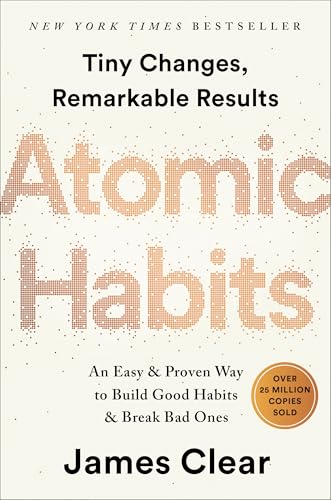
by James Clear · 2018
The definitive guide to building good habits and breaking bad ones through tiny 1% improvements that compound into extraordinary results.
Rules for focused success in a distracted world — why deep, concentrated work is the superpower of the 21st century, and how to cultivate it.
As an Amazon Associate I earn from qualifying purchases.