
Personal Development 9 min read
The 4-Hour Workweek
by Timothy Ferriss · 2007
4.5
The cult manifesto for lifestyle design: how to escape the 9-5, automate your income, live anywhere in the world, and stop deferring life until retirement.
Amazon Associate link
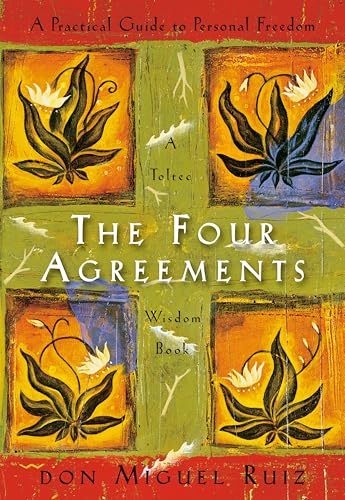
by don Miguel Ruiz · 1997
Don Miguel Ruiz is a nagual, or master, in the Eagle Knight lineage of Toltec spiritual teachers — descendants of an ancient tradition centered on Teotihuacan, the city of pyramids outside Mexico City known as the place where “Man Becomes God.” The Four Agreements distills that lineage’s teaching on personal freedom into a single practical claim: most human suffering comes from agreements we never consciously chose — rules absorbed in childhood the way a dog or cat is trained, through reward and punishment — and that suffering can be undone by consciously adopting four new agreements instead. The book frames itself less as philosophy and more as a program: simple enough, Ruiz says, that a child could understand it, but demanding enough that it takes real will to practice.
Ruiz opens the book by naming his own teachers: his mother Sarita, credited with teaching him unconditional love; his father Jose Luis, credited with teaching him discipline; and his grandfather Leonardo Macias, whom he identifies as the one who first opened the door to Toltec knowledge for him.
The book then traces its own lineage. The Toltec, per Ruiz, were not a nation or a race but a society of scientists and artists who gathered as masters and students at Teotihuacan to preserve spiritual knowledge, later forced into secrecy by European conquest and by apprentices who misused what they’d learned. Ruiz presents himself as a nagual of the Eagle Knight line, tasked with finally returning that knowledge to a wider public.
He grounds the rest of the book in an origin story: a man living near a city surrounded by mountains roughly three thousand years ago, dissatisfied with what he was being taught as a medicine man, dreamed one night that he watched his own body sleeping. Waking outside under a new moon, he became convinced that everything visible — himself included — was made of light, and that matter itself works like a mirror, reflecting that light back and forth between people. He called himself the Smokey Mirror: everyone is a mirror for everyone else, he said, but a wall of smoke — the accumulated interpretations each person layers over reality — keeps any two mirrors from truly recognizing one another. That smoke, in Ruiz’s system, is what the rest of the book calls the Dream.
Ruiz’s central claim is that everyone is dreaming all the time, whether asleep or awake, and that long before any of us were born, other humans built a shared “dream of the planet” — the entire accumulated system of a society’s laws, religions, customs, and expectations. Children absorb this dream through what Ruiz calls domestication: the same reward-and-punishment training used on a dog or a cat, except conducted by parents, teachers, and clergy who withhold or grant attention depending on whether a child’s behavior matches what’s expected. Nobody chooses their native language, their religion, or their name, Ruiz points out — we simply agree to what’s placed in front of us, and agreement is how a belief gets stored.
The result, in his framework, is an internal “Book of Law” — the total record of everything a person has agreed to believe — policed by an inner Judge and suffered by an inner Victim, the part of the mind that absorbs blame, guilt, and shame every time the Judge finds a thought or action wanting. Ruiz’s own estimate of how much of that Book of Law is actually true: “Ninety-five percent of the beliefs we have stored in our minds are nothing but lies.” The Toltecs had a word for the resulting inner noise — mitote, a mind talking to itself in a thousand contradictory voices at once, which practitioners in India called by another name: maya, illusion.
Ruiz calls this the most important and hardest agreement to keep. His reasoning starts from the Gospel of John — “In the beginning was the word, and the word was with God, and the word is God” — and extends into a claim that speech is the mechanism by which every human creates their reality, for better or worse. As a worst-case illustration of the word’s destructive power, he points to Hitler as the extreme case: a single person who, Ruiz argues, used nothing but the spoken word to turn an entire nation of capable, intelligent people toward a world war.
Word choices from people who love us can be just as damaging on a smaller scale. Ruiz tells of a mother, exhausted and in pain from a headache, who snaps at her joyfully singing daughter to be quiet because her voice is ugly — a single sentence the daughter believes for the rest of her life, giving up singing and growing shy about speaking in front of others entirely. Gossip, Ruiz argues, is this same mechanism at a societal scale, which is why he names it a computer virus: malicious code slipped into a mind using the same language that mind already trusts, so that entire communities end up operating on corrupted information without ever realizing it. The etymology he offers for “impeccable” traces it to the Latin pecatus, “sin,” with the prefix im- meaning “without” — to be impeccable with your word, in his reading, is simply to stop using it against yourself.
If someone calls you stupid without knowing you, Ruiz argues, that says everything about their own agreements and nothing about you. He offers his own reaction to praise and insult as a working example: he says he doesn’t take it personally when people tell him he’s the best, and he doesn’t take it personally when the same people, upset with him later, call him the worst. Both reactions, in his framework, describe the speaker’s inner world, not his own.
Taken to its logical extreme, Ruiz pushes the agreement further than most readers would expect: “Even if someone got a gun and shot you in the head, it was nothing personal.” The payoff for actually living this way, he argues, is substantial — practicing just this agreement alongside the first, he claims, is enough to break seventy-five percent of the small, accumulated agreements that keep a person trapped in unhappiness.
Ruiz’s example: you pass someone you’re attracted to in a mall, they smile, and by the time you’ve walked away you’ve built an entire imagined relationship — sometimes, he notes, all the way to an imagined marriage — purely out of assumption. He extends the same pattern into real relationships: partners who assume their spouse already knows what they want, and feel betrayed when that unspoken expectation isn’t met, are, in his view, one of the biggest sources of unnecessary conflict between people who love each other.
His proposed fix is blunt honesty rather than diplomacy: “If you love me the way I am, okay, take me. If you don’t love me the way I am, okay, bye-bye. Find someone else.” The chapter closes by naming the practical alternative to assuming — asking — and introduces a distinction Ruiz returns to throughout the book: a “white magician” uses words to create, give, and share, while a “black magician” uses the same words to harm, whether or not that harm is intended.
This agreement, Ruiz says, is what makes the other three sustainable, because “best” is never fixed — it changes hour to hour depending on whether you’re rested or exhausted, healthy or sick. He illustrates the point with a story about a student who asks a Buddhist master how long it will take to reach enlightenment meditating four hours a day, and is told perhaps ten years; when the student offers to double his effort to eight hours a day, the master answers that it will now perhaps take twenty, because the student would be sacrificing the very joy and life he’s supposedly meditating to protect.
Ruiz’s practical case for the agreement is that it removes the inner Judge’s leverage entirely: if you’ve genuinely done your best, there’s no verdict left to hand down, no guilt to answer to. He offers Forrest Gump, in passing, as an example of someone who wasn’t especially strategic but who did his best at everything and was rewarded for it regardless.
Ruiz’s estimate of how widespread the problem is: in any society, for every thousand people, nine hundred and ninety-nine are completely domesticated. Ruiz compares the combination of the Judge, the Victim, and the accumulated belief system to a parasite — a monster with a thousand heads, each head one of a person’s fears, feeding specifically on fear-based emotion. He offers three ways to starve or destroy it: face each fear individually, one at a time; stop generating the fear-based emotions that feed it in the first place; or undergo what he calls “the initiation of the dead,” a symbolic death ritual he says appears across traditions in Egypt, India, Greece, and America, in which the old self dies so the parasite dies with it.
Central to breaking any individual agreement, in his framework, is forgiveness — not because the people who wronged you deserve it, but because holding the grudge keeps costing you personally. He also proposes a specific thought experiment: imagining you have exactly one week left to live, and asking what you’d stop pretending about immediately. The distinction he draws between a warrior and a victim in this process is precise: “the victim represses, and the warrior refrains” — the difference between swallowing an emotion out of fear and consciously choosing when to express it.
Ruiz closes by asking readers to imagine, deliberately, a version of their own life without the fear of being judged, without the need to justify their existence to anyone, in which even the mitote — the mental fog of a thousand contradictory voices — has, in his words, gone on a permanent vacation. He’s explicit that he isn’t proposing anything new: “Moses called it the Promised Land, Buddha called it Nirvana, Jesus called it Heaven, and the Toltecs call it a New Dream” — different names, in his reading, for the same available state of mind. His closing argument is that both suffering and happiness are choices rather than conditions imposed from outside: his own choice, he says, is to live in heaven, and he leaves the reader with the same question.
“Ninety-five percent of the beliefs we have stored in our minds are nothing but lies.”
“Even if someone got a gun and shot you in the head, it was nothing personal.”
“The victim represses, and the warrior refrains.”
“Moses called it the Promised Land, Buddha called it Nirvana, Jesus called it Heaven, and the Toltecs call it a New Dream.”
The Four Agreements is best suited for readers looking for a short, direct framework rather than an extended argument — at under 200 pages, it makes its entire case in the space many books would spend on a single chapter. It draws on Toltec spiritual tradition rather than clinical psychology, so readers comfortable with concepts like dreams, magic, and a Creator as organizing metaphors will get more out of it than readers looking for empirical research.
It’s a natural fit for anyone drawn to how gossip, criticism, or a single remark from childhood can still shape behavior decades later, and for anyone looking for a small number of memorable, repeatable rules rather than a long list of habits to track. Ruiz is explicit that understanding the four agreements is the easy part; he spends real time on how difficult they are to actually practice, which gives the book a more grounded tone than its simplicity might suggest.
What is The Four Agreements about? It’s don Miguel Ruiz’s distillation of Toltec teachings on personal freedom into four practical commitments: being impeccable with your word, not taking anything personally, not making assumptions, and always doing your best. Ruiz argues that most suffering comes from agreements about ourselves and the world that we absorbed as children without ever consciously choosing them.
What are the Four Agreements? Be impeccable with your word. Don’t take anything personally. Don’t make assumptions. Always do your best. Ruiz presents them in that order deliberately — the first three describe how to communicate and interpret the world, while the fourth agreement is what makes the other three sustainable over time, since your “best” will vary from day to day.
Is The Four Agreements worth reading? Yes, particularly if you want a short, practical entry point into ideas about self-criticism and inherited beliefs rather than a research-driven approach. It’s a quick read, at under 200 pages, and Ruiz’s central claim — that most of what we believe about ourselves was installed rather than chosen — is a genuinely useful lens even for readers who don’t connect with the book’s spiritual framing.
What does “don’t take anything personally” mean in The Four Agreements? It means recognizing that what other people say and do reflects their own agreements, fears, and beliefs, not facts about you. Ruiz’s own example: he says he doesn’t take it personally whether people call him the best or the worst, because either reaction describes the speaker’s state of mind, not his.
Ready for the full experience?
Buy on Amazon →As an Amazon Associate I earn from qualifying purchases.
by Timothy Ferriss · 2007
The cult manifesto for lifestyle design: how to escape the 9-5, automate your income, live anywhere in the world, and stop deferring life until retirement.

by Stephen R. Covey · 1989
The classic framework for personal and professional effectiveness — 7 habits that build character and move you toward true interdependence.
by James Clear · 2018
The definitive guide to building good habits and breaking bad ones through tiny 1% improvements that compound into extraordinary results.
A Toltec master's four-part framework for personal freedom — impeccable words, not taking things personally, and dropping assumptions you never chose.
As an Amazon Associate I earn from qualifying purchases.