
Personal Development 9 min read
The 4-Hour Workweek
by Timothy Ferriss · 2007
4.5
The cult manifesto for lifestyle design: how to escape the 9-5, automate your income, live anywhere in the world, and stop deferring life until retirement.

Amazon Associate link
by Eckhart Tolle · 1997
Eckhart Tolle didn’t set out to become a spiritual teacher. Until his late twenties he lived in almost continuous anxiety, with periods of suicidal depression. One night, not long after his twenty-ninth birthday, an intense psychological crisis triggered something that took him years to fully make sense of — and by morning, the anxious, suffering self he’d spent years believing he was had simply collapsed. He spent the next two years sitting on park benches in a state of deep peace, with no job, no home, and no fixed identity, before people began approaching him asking how to find what he obviously had. The Power of Now, first published in Canada in 1997, is the book-length answer he eventually wrote.
Its single argument, restated from a dozen angles across ten question-and-answer chapters: nearly all human suffering comes from identifying with the mind — an endless replay of the past and an anxious rehearsal of the future — instead of living in the only moment that has ever actually existed, the Now. Tolle borrows the Buddha’s definition of enlightenment: the end of suffering. Nothing superhuman about it. Just presence.
The book opens with Tolle’s own story. Before the age of thirty, he describes a life dominated by dread. Then, one night, a single repeating thought — “I cannot live with myself any longer” — suddenly struck him as strange: if he couldn’t live with “himself,” there had to be two of him, an “I” and a “self.” Maybe only one was real. His mind stopped. He felt pulled into what he describes as a vortex of energy, heard the words “resist nothing” as if spoken inside his chest, and let himself fall into what felt like a void. He woke the next morning to birdsong he’d never really heard before, feeling as though the room — and the light in it — had come alive for the first time. The unhappy self he’d carried for years never fully returned.
Tolle’s foundational claim is that most people are so identified with the voice in their head — the constant, involuntary commentary on everything — that they mistake it for who they are. He estimates that 80 to 90 percent of most people’s thinking is repetitive and useless, and because of its often negative, dysfunctional character, actively harmful. The fix isn’t to stop thinking; it’s to become the “watcher” of your own thoughts, creating a gap between you and the mental noise. He illustrates the scale of this collective restlessness with an anecdote from Carl Jung, who once described a Native American chief telling him that white people always seem to be seeking something, “always uneasy and restless.”
One of the book’s most distinctive ideas is the “pain-body” — an accumulated field of old emotional pain that Tolle treats almost like a separate entity living inside you. It has two modes: dormant and active. In a deeply unhappy person, it can be active up to 100 percent of the time. Left unwatched, it looks for situations that let it feed — an argument, a slight, an old grievance — because pain, in Tolle’s framing, can only feed on more pain. The way out isn’t suppression; it’s noticing the pain-body the moment it stirs and simply staying present with it, without turning it into a story about yourself.
Tolle draws a hard line between “clock time” — using time practically to plan a trip, learn from a mistake, or set a goal — and “psychological time,” which is identifying your sense of self with the past and compulsively projecting into the future. He argues psychological time, at collective scale, is genuinely dangerous: ideologies like communism, he says, operate on the assumption that a mind-made “better world” in the future justifies present-day atrocity, and he points to an estimated fifty million people killed in pursuit of a communist utopia in Russia, China, and other countries as the result. The antidote at the individual level is smaller and more immediate: keep using clock time for practical matters, but keep returning your attention to what’s actually happening right now.
Tolle’s core practice isn’t meditation in the traditional sense — it’s learning to feel the “inner body,” the subtle field of aliveness inside your physical form, as a way of staying rooted in the present. He borrows Jesus’s parable of two men building houses, one on sand and one on rock, to describe the difference between a life with no inner foundation and one anchored in present-moment awareness. He also distinguishes this inner energy field from what he calls chi: chi is movement, a bridge between you and the deeper Source, while the Unmanifested itself — the stillness underneath everything — is what chi flows from and back into.
Beyond the body, Tolle points to silence and empty space as everyday doorways into what he calls the Unmanifested — the formless source underneath all form. He notes that even solid matter is, at the atomic level, nearly 100 percent empty space, and that over 100 billion galaxies are already detectable with modern telescopes — but argues that the empty space surrounding it all is even more awe-inspiring than the galaxies themselves. To illustrate what sustained presence looks like in practice, he retells the old account of Zen masters testing their students by creeping up and striking them with a stick — a fully present student would sense it coming and step aside.
Tolle is blunt about romantic relationships: until both people access real presence, most “love” relationships are really addictive attachment, cycling between euphoria and conflict as each partner’s pain-body gets triggered by the other’s. His proposed shift isn’t finding a better partner — it’s stopping the search for someone else to complete you, since the relationship’s real value, he argues, is in making you more conscious rather than making you happy. He also retells Jesus’s parable of the lost son, using it to describe how a period of apparent failure or unconsciousness can precede a return to a deeper, more solid sense of self.
The book’s final turn distinguishes happiness — which depends on conditions going your way — from inner peace, which doesn’t. Tolle illustrates nonresistance with two animal anecdotes: ducks that get into a brief fight, then swim off and vigorously flap their wings to shake off the excess energy before continuing on as if nothing happened, and his own line that he’s “lived with several Zen masters — all of them cats.” A Buddhist monk once summarized twenty years of practice to him in a single sentence: “All that arises passes away.” He also cites Marcus Aurelius’s instruction, written two thousand years ago, to accept whatever comes as if you had chosen it yourself, and retells the story of Banzan, a would-be Zen master who finally became enlightened after overhearing a butcher insist that every single piece of meat he sold was the best one. The book’s closing concept, surrender, is explicitly not resignation — it’s the discipline of accepting the present moment completely while still taking whatever action the moment calls for.
“I cannot live with myself any longer.”
“Resist nothing.”
“Die before you die.”
“Chi is movement; the Unmanifested is stillness.”
The Power of Now is for readers who have tried more conventional self-help — goal-setting, productivity systems, positive thinking — and still feel a low-grade background anxiety they can’t quite name. Its question-and-answer format, built from Tolle’s actual meditation classes and counseling sessions, makes dense spiritual ideas feel like an ongoing conversation rather than a lecture.
It’s less useful as a step-by-step system and more useful as a shift in orientation — readers looking for a rigid daily plan may find its instructions (“feel your inner body,” “watch the thinker”) frustratingly abstract at first. But for anyone dealing with chronic overthinking, unresolved emotional reactivity, or a sense that life is always happening somewhere other than right here, it’s one of the most widely read entry points into present-moment awareness in print.
What is “the Now” according to Eckhart Tolle? The Now is Tolle’s term for the present moment as the only point in time that has ever actually existed — the past is a memory trace and the future is a mental projection, but life itself only ever happens now. He argues that accessing the Now, rather than living through memory and anticipation, is the single point of access to inner peace.
What is the “pain-body” in The Power of Now? The pain-body is Tolle’s term for an accumulated field of old emotional pain that behaves almost like a separate entity inside you, alternating between dormant and active states. It seeks out situations — arguments, old grievances, conflict — that let it “feed,” and the way to weaken it is to notice it the moment it activates rather than getting pulled into acting it out.
Is The Power of Now worth reading? For readers dealing with chronic anxiety or overthinking, yes — it’s rated 4.7 out of 5 on Amazon from tens of thousands of reviews and remains the top-ranked meditation title in its category decades after publication. Its question-and-answer format makes it more approachable than its dense subject matter might suggest, though some readers find its more esoteric passages abstract.
What’s the difference between “clock time” and “psychological time” in the book? Clock time is the practical use of time — planning, learning from past mistakes, working toward a goal — which Tolle says is fine to use. Psychological time is identifying your sense of self with the past or compulsively projecting into the future, which he argues is the root of most unnecessary suffering, both individually and, at collective scale, historically.
Ready for the full experience?
Buy on Amazon →As an Amazon Associate I earn from qualifying purchases.
by Timothy Ferriss · 2007
The cult manifesto for lifestyle design: how to escape the 9-5, automate your income, live anywhere in the world, and stop deferring life until retirement.

by Stephen R. Covey · 1989
The classic framework for personal and professional effectiveness — 7 habits that build character and move you toward true interdependence.
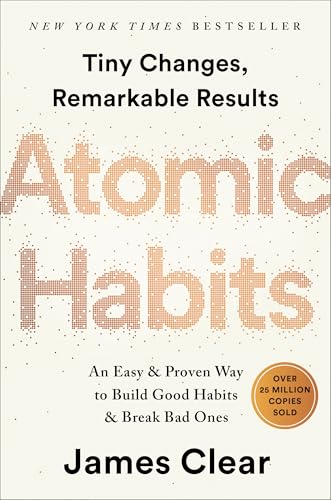
by James Clear · 2018
The definitive guide to building good habits and breaking bad ones through tiny 1% improvements that compound into extraordinary results.
A guide to spiritual enlightenment built around one idea: almost all suffering comes from living in your head instead of the only moment that exists.
As an Amazon Associate I earn from qualifying purchases.