Finance 8 min read
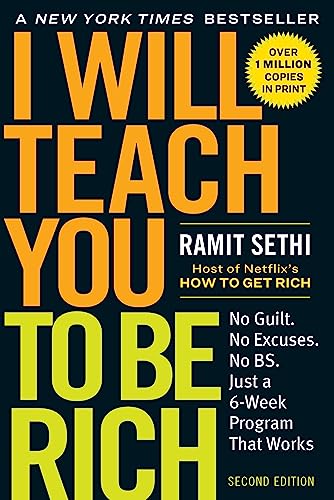
I Will Teach You to Be Rich
by Ramit Sethi · 2019
4.6
A no-guilt personal finance system for your 20s and 30s: automate savings and investing, spend on what you love, and cut everything else.

Amazon Associate link
by Benjamin Graham · 1949
Warren Buffett read the first edition of this book in early 1950, at age nineteen, and called it “by far the best book about investing ever written.” He still says the same today. Benjamin Graham — born Benjamin Grossbaum in London in 1894 — learned his lessons the hard way: his family fell into poverty after his father’s death, his mother was wiped out trading on margin during the Crash of 1907, and Graham himself survived a near-70% loss during the Great Crash of 1929–1932 before building one of the best long-term records on Wall Street, with his Graham-Newman Corp. gaining at least 14.7% annually from 1936 to 1956, versus 12.2% for the market as a whole. This revised edition pairs Graham’s original text with modern chapter-by-chapter commentary from Jason Zweig and an appendix by Buffett himself. Its central argument: the intelligent investor’s real advantage has nothing to do with IQ and everything to do with temperament — patience, discipline, and an insistence on never paying more for a business than it’s worth.
As far back as 1934, in his textbook Security Analysis, Graham offered a precise test, one he repeats word for word later in this very book: “An investment operation is one which, upon thorough analysis, promises safety of principal and an adequate return.” Anything that doesn’t meet that bar is speculation. Graham traces how far this distinction had drifted from public understanding: in 1948, right before stocks began their greatest advance in history, a survey found that more than 90% of Americans said they opposed buying common stocks, mostly because they saw it as “not safe, a gamble” or something they simply weren’t familiar with.
Zweig’s commentary documents the same confusion resurfacing during the late-1990s dot-com mania. Online brokers ran ads promising instant riches — one showed a scruffy tow-truck driver telling a passenger that the tropical photo on his dashboard wasn’t a vacation shot but his own home, then topping the joke by revealing that his “island” was, technically, a country; another showed two housewives back from a jog, one of whom logs onto her computer and exults that she’d “just made about $1,700.” By 1999, at least six million people were trading online, and roughly a tenth of them were day-trading; a 25-year-old former waiter in Queens was trading stocks up to ten times a day, expecting to earn $100,000 that year. On December 20, 1999, Juno Online Services announced it would deliberately lose money by making all its services free — and its stock rocketed from $16.375 to $66.75 in two days. Confusion ran so deep that traders once nearly tripled the stock of an obscure building-maintenance company, Temco Services, simply because its ticker (TMCO) was mistaken for Ticketmaster Online (TMCS).
Graham’s rule for handling the gambling instinct, which he considers a normal part of human nature: if you want to speculate, wall that money off completely from your investing funds, and never risk more than about 10% of your total portfolio on it.
Graham divides investors into two types, with no comfortable middle ground. The defensive (or passive) investor’s chief goal is avoiding serious mistakes and losses, plus freedom from constant effort and decision-making. The enterprising (or active) investor is willing to devote real time and care to finding securities that are both sound and more attractive than average — and over the decades can expect a somewhat better return as compensation for that extra work. Graham is explicit that trying to be a little of both is a compromise more likely to produce disappointment than real achievement.
For years, Graham’s standing recommendation for the defensive investor was a simple split: never let bonds fall below 25% or exceed 75% of the portfolio, with common stocks making up the rest. A straight 50/50 division — rebalanced whenever market movements push the ratio more than about 5 percentage points out of line — is his default for an investor who wants a policy simple enough to follow without agonizing over market forecasts.
Graham’s most famous idea is also his simplest. Imagine you own a small stake in a private business, and one of your partners — call him Mr. Market — shows up every single day to name a price at which he’ll either buy your share or sell you more of his. Some days his price reflects the business’s real prospects. Other days, swept up by enthusiasm or fear, his price is close to absurd.
The intelligent investor’s job isn’t to be swayed by Mr. Market’s mood. You’re free to sell to him when his offer is generously high, and free to buy from him when his offer is foolishly low — but the rest of the time, you’re better off ignoring him entirely and judging the business on its own operating results. Graham’s practical rule of thumb, distilled from this idea: never buy a stock immediately after a substantial rise, or sell one immediately after a substantial drop. Price fluctuations, in his view, exist to serve you — not to instruct you.
If Graham had to compress his entire philosophy into three words, they would be margin of safety — the thread, he says, running through the whole book. For bonds, the concept is arithmetic: a railroad should have earned its total fixed charges at least five times over (before tax) across a period of years for its bonds to qualify as investment-grade, so that a real cushion exists before a decline in income could hurt bondholders. For stocks, Graham’s classic version of the same idea: if a company’s earning power is 9% of its price and bonds pay 4%, the stockholder is banking roughly a 5-point annual margin in his favor — and across a diversified list of twenty or more such stocks, that margin makes a favorable outcome very likely, without requiring any special foresight.
Zweig’s commentary supplies a cautionary modern illustration: fiber-optics company JDS Uniphase reported $673 million in sales for the four quarters ending December 1999, but lost $313 million doing it, and had tangible assets of just $1.5 billion — yet its stock touched $153 a share on March 7, 2000, putting a roughly $143 billion price tag on the company. By the end of 2002 the stock had collapsed to $2.47. Anyone who bought at the peak and held on would need more than 43 years at a 10% annual return just to break even. Graham sums up the chapter with four rules of business-like investing, under a section he titles “To Sum Up”: know your business, don’t let others run it unsupervised, never enter an operation without a reasonable calculation of profit, and have the courage of your own knowledge and reasoning.
Graham traces the seductive but ultimately hollow history of mechanical trading systems. The famous Dow theory delivered an almost unbroken string of paper profits from 1897 into the early 1960s — including a well-timed sell signal about a month before the 1929 crash — but from 1938 onward, simply buying and holding the Dow would have beaten it for nearly thirty straight years. Zweig’s commentary extends the pattern into recent decades: the “January effect,” in which small stocks reliably outperformed around the turn of the year, delivered an 8.5-percentage-point edge from 1962–1979 according to finance professor William Schwert, a gap that shrank to 4.4 points in the 1980s and 5.8 points in the 1990s as more traders piled in to exploit it — and transaction costs on small stocks can run as high as 8%, eating up much of what’s left.
The same fate met more recent fads. A 1996 book claimed a stock-picking formula that turned $10,000 into over $8 million between 1954 and 1994, and its author even earned a U.S. patent for it and launched four mutual funds on the strength of it — yet two of those funds performed so badly they were shut down by early 2000. A similarly hyped “Foolish Four” strategy, built around the five lowest-priced, highest-yielding stocks in the Dow, was said to have beaten the market by more than ten percentage points a year for a quarter-century; in the very year after it was popularized, its four component stocks lost 14% while the Dow itself fell just 4.7%. Zweig names this pattern “Graham’s Law”: mechanical formulas for beating the market are, in his words, “a kind of self-destructive process—akin to the law of diminishing returns” — either because they were random statistical flukes all along, like the Foolish Four, or because publicizing a formula that once worked, like the January effect, erodes the very edge that made it work.
A stock’s quoted price and the underlying business’s real value are related but not identical — and Graham illustrates the gap with the story of the Great Atlantic & Pacific Tea Company. A&P shares traded as high as 494 in 1929, fell to 104 by 1932, and then, during the 1938 recession, collapsed to 36 — a price so low that the company’s entire stock, preferred and common combined, was valued at $126 million even though A&P held $85 million in cash alone plus $134 million in working capital. The following year the stock nearly tripled to 117½. Decades later, in 1961, the split-adjusted shares reached the equivalent of 705 — 30 times earnings, against 23 for the Dow as a whole — before falling by more than half within a year and drifting down to just 18 by 1972.
Graham finds the same pattern in the era’s most admired growth companies: IBM fell from 607 to 300 in just seven months during 1962–63, and Xerox fell from 171 to 87 over the same stretch — not because either company’s long-term prospects had changed, but because the market’s confidence in the premium it had assigned them evaporated. The paradox Graham draws out: the more spectacular a company’s reputation, the further its price tends to drift from tangible value — meaning, counterintuitively, that a company’s very success can make its stock more speculative, not less.
The book’s appendix reprints a 1984 Columbia University talk by Warren Buffett, answering the academic claim that beating the market is pure luck. Buffett makes his case with a thought experiment: if 225 million Americans each flipped a coin and losers dropped out daily, after twenty mornings about 215 people would have called ten straight flips correctly, turning a dollar into roughly a million — and 225 million orangutans would produce the same 215 “winners” by pure chance. His test for whether skill, not luck, is at work: if 40 of those 215 winning orangutans all came from the same zoo in Omaha, you’d want to know what that zoo was feeding them.
Buffett’s zoo is Graham-and-Doddsville — a group of investors who trained directly or indirectly under Graham, applied his price-versus-value discipline in wildly different ways, and still compiled results that chance alone can’t explain. Walter Schloss, who never attended college, built a career on buying stocks nobody wanted at a fraction of what they were worth. Tom Knapp went from postwar beach bum to Columbia MBA to co-founding the firm Tweedy, Browne. Rick Guerin, a former IBM salesman with no business degree, turned a 316% market gain between 1965 and 1983 into a personal 22,200%. And the Washington Post Company itself was quoted at just $80 million in 1973, even though its properties — the Post, Newsweek, and several TV stations — could have been sold to any of ten buyers for at least $400 million, and were worth roughly $2 billion by the time Buffett gave his talk. Buffett’s own summary of the underlying logic: when you build a bridge, you insist it can carry 30,000 pounds, but you only drive 10,000-pound trucks across it.
Zweig’s commentary insists that the biggest risk to any portfolio isn’t a bad stock — it’s the investor holding it. He revisits Sir Isaac Newton, who sold his South Sea Company shares for a 100% profit in the spring of 1720, then watched the mania continue, bought back in at a much higher price, and lost the equivalent of more than $3 million in today’s money — afterward banning anyone from mentioning “South Sea” in his presence. Newton is said to have muttered afterward that he “could calculate the motions of the heavenly bodies, but not the madness of the people.” Nearly three centuries later, Long-Term Capital Management — a hedge fund run partly by two Nobel Prize–winning economists — lost more than $2 billion in a matter of weeks in 1998 on a bet that the bond market would return to normal.
Drawing on the work of psychologist Daniel Kahneman, Zweig frames the real test of any investment decision as two questions: is your confidence well-calibrated — do you actually understand this as well as you think you do — and have you correctly anticipated your own regret — do you know how you’ll react if you turn out to be wrong? As psychologist Paul Slovic has argued, risk combines two separate things in equal measure: how likely an outcome is, and how bad it would be if it happened — and a 1999 Money Magazine survey found that nearly one in ten Americans had put at least 85% of their money into internet stocks. Graham’s entire system, in Zweig’s reading, exists to protect an investor from exactly that kind of exposure, so that no single mistake — however confident it felt at the time — can ever be catastrophic.
“You are neither right nor wrong because the crowd disagrees with you. You are right because your data and reasoning are right.”
“The investor’s chief problem — and even his worst enemy — is likely to be himself.”
“While enthusiasm may be necessary for great accomplishments elsewhere, on Wall Street it almost invariably leads to disaster.”
“Never buy a stock immediately after a substantial rise or sell one immediately after a substantial drop.”
The Intelligent Investor is best suited for anyone who already owns stocks, or is about to, and wants a permanent mental framework rather than a set of tips with an expiration date. First published in 1949 and revised roughly every five years since, Zweig’s commentary shows its warnings applying just as directly to the dot-com crash as to Graham’s own era of railroad bonds and 1970s inflation. It’s especially valuable for anyone who has lived through a market mania — or worries about missing or repeating the next one — and wants to understand why formulas, forecasts, and hot tips fail with such reliability.
It is not a light read: Graham’s original prose is dense, occasionally technical, and rooted in an earlier era of bond tables and stock quotations. But Zweig’s chapter-by-chapter commentary translates the underlying principles into modern, concrete examples throughout — which is largely why Warren Buffett, arguably the most successful investor alive, still calls it simply the best book on investing ever written.
What is The Intelligent Investor about? It’s a framework for individual investors built around one core distinction: investing means demanding safety of principal and an adequate return after thorough analysis; anything else is speculation. Benjamin Graham lays out how to tell the two apart and how to build a portfolio — whether passive or active — that survives Wall Street’s recurring cycles of euphoria and panic.
What is the main lesson of The Intelligent Investor? Margin of safety — Graham’s own three-word summary of the entire book. Never pay a price so close to a business’s true value that ordinary bad luck or a small miscalculation could turn a sound decision into a loss. The rest of the book is really an extended argument for why this single habit matters more than forecasting skill or market timing.
Is The Intelligent Investor worth reading? Yes. Warren Buffett read the first edition in 1950, at nineteen, and called it “by far the best book about investing ever written” — a verdict he still holds today. This revised edition adds chapter-by-chapter commentary from Jason Zweig connecting Graham’s principles to the dot-com crash, plus an appendix by Buffett himself on why Graham’s disciples have consistently beaten the market.
What is the “margin of safety” principle in The Intelligent Investor? It’s Graham’s rule that the price paid for an investment should leave enough cushion — through a low price relative to value, or earnings well above what’s needed to cover a bond’s interest — that the investor doesn’t need to be right about the future to come out ahead. Graham calls it, literally, the central concept of investment.
Ready for the full experience?
Buy on Amazon →As an Amazon Associate I earn from qualifying purchases.
by Ramit Sethi · 2019
A no-guilt personal finance system for your 20s and 30s: automate savings and investing, spend on what you love, and cut everything else.
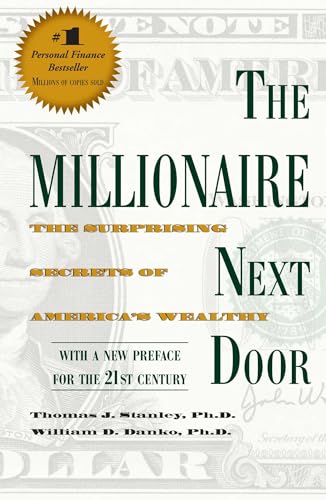
by Thomas J. Stanley & William D. Danko · 1996
The landmark study revealing that most American millionaires are ordinary people who live in ordinary houses and build wealth below their means.
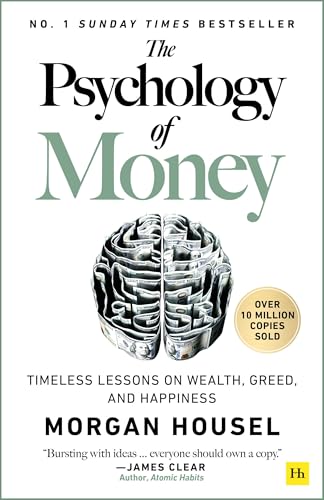
by Morgan Housel · 2020
Timeless lessons on wealth, greed, and happiness — exploring why smart people make irrational financial decisions and how behavior matters more than knowledge.
The foundational text of value investing: why Wall Street's formulas fail, and why margin of safety — not forecasting — protects your money.
As an Amazon Associate I earn from qualifying purchases.