Finance 8 min read
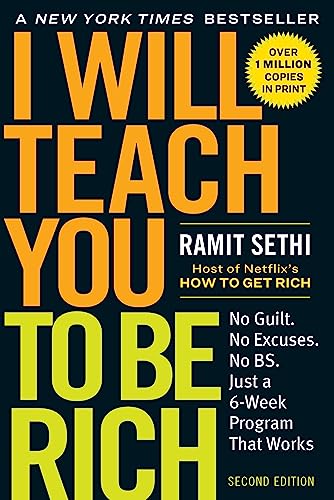
I Will Teach You to Be Rich
by Ramit Sethi · 2019
4.6
A no-guilt personal finance system for your 20s and 30s: automate savings and investing, spend on what you love, and cut everything else.
Amazon Associate link
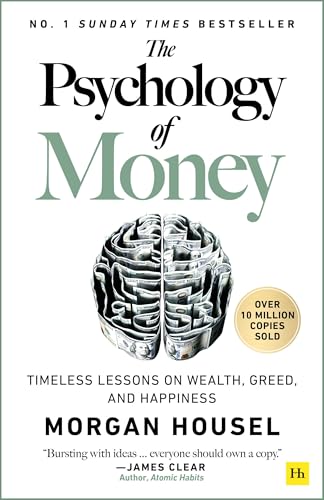
by Morgan Housel · 2020
Doing well with money has little to do with how smart you are and everything to do with how you behave. Morgan Housel argues that financial success is a soft skill — and that the biggest obstacles to wealth aren’t mathematical but psychological: greed, fear, ego, and the inability to recognize how luck and risk shape outcomes. This is not a book about what to do with money. It’s about understanding why you do what you do with it.
Your financial behavior is shaped entirely by your personal history. Someone who grew up during the Great Depression thinks about risk differently than someone who came of age in the bull market of the 1990s. Someone raised in poverty sees a lottery ticket as a reasonable investment in a dream — not as a statistically poor decision. What looks irrational from the outside usually makes perfect sense given the experiences that person has lived.
This is the most generous framework in the book: before judging anyone’s financial choices — including your own — recognize that everyone is playing a different game with different information, shaped by a world they’ve experienced in a unique way. The rational behavior in someone else’s circumstances might look completely different from yours.
Bill Gates attended one of the only high schools in the world that had a computer in 1968. His best friend at Lakeside School, Kent Evans — equally talented, equally ambitious — died in a mountaineering accident before graduating. One got the opportunity of a lifetime. The other encountered a one-in-a-million risk. The same force, in opposite directions.
Housel’s lesson: success and failure are never entirely due to individual effort. When you credit your wins entirely to skill and your losses entirely to bad luck, you’re lying to yourself. The most honest accounting of anyone’s financial life includes a healthy portion of luck and risk that can’t be controlled. Be careful who you admire and what lessons you think their story teaches.
Rajat Gupta was worth $100 million. He risked everything for more and went to prison for insider trading. Bernie Madoff ran a legitimate, highly profitable brokerage — and still built a massive Ponzi scheme on top of it. The thing that destroyed both men wasn’t poverty. It was an insatiable appetite for more.
Housel describes this as one of the most critical financial skills: the ability to stop moving the goalposts. Social comparison makes this nearly impossible — there is always someone with more. The moment you tie your sense of enough to what others have, you’ve entered a game with no finish line. Happiness is results minus expectations. Protecting what you have — your reputation, your relationships, your freedom — is worth more than any additional gain.
Warren Buffett’s net worth is roughly $84 billion. Of that, $81.5 billion was accumulated after he qualified for Social Security. The secret to his success isn’t his average annual return — it’s the duration of compounding. He began investing seriously at age 10 and never stopped.
If Buffett had started at 30 and retired at 60 with the same annual returns, he’d be worth $11.9 million — extraordinary, but 99.9% less than he actually accumulated. The math of compounding is exponential, not linear. Human brains are wired for linear thinking, which means we consistently underestimate how powerful long, uninterrupted compounding is. The implication: starting early and staying consistent beats brilliant strategy started late every single time.
Jesse Livermore made the equivalent of $3 billion in a single day during the 1929 crash. By 1933, he had lost everything. Getting money requires risk-taking, optimism, and putting yourself out there. Keeping it requires the opposite — humility, frugality, and an acceptance that what you’ve made can be taken away just as fast.
Housel’s advice: more than you want high returns, want to be financially unbreakable. The ability to survive downturns without being forced to sell is more valuable than picking great investments. Compounding requires staying in the game. The most important financial question isn’t “how do I maximize returns?” It’s “how do I avoid ruin?”
Heinz Berggruen became one of history’s greatest art dealers not by picking masterpieces every time, but by buying vast quantities of art and letting a small number of tail events — Picasso, Matisse — generate returns that dwarfed everything else. The same logic applies to investing: 40% of all Russell 3000 Index companies have lost at least 70% of their value over time and never recovered. Yet the index itself is up 73-fold since 1980. A tiny percentage of massive winners did all the work.
The practical takeaway: it’s normal for many things to fail. Great investors are wrong often. Great companies launch failed products constantly. What matters is that when the few big winners arrive, you’re still holding them. Being wrong most of the time is acceptable — even expected — as long as you’re right enough when it counts.
The highest form of wealth is not a big house or a luxury car. It’s the ability to wake up and decide how you want to spend your day. Autonomy over your time is the most powerful dividend money can pay.
Housel traces this insight through decades of psychology research: controlling your own schedule is a more reliable predictor of happiness than income, prestige, or possessions. What money actually buys — at every income level — is options. The freedom to say no to a job you hate. To take care of a sick parent. To pursue work that pays less but means more. Build your financial life around preserving that freedom, not maximizing your stuff.
When you see someone driving a Ferrari, you don’t think about how great the driver is. You think about how great the car is. You imagine yourself in that car. This, Housel argues, is the fundamental paradox of conspicuous spending: we buy expensive things hoping others will admire us, but they’re too busy admiring the object — or imagining themselves with it — to admire us.
Wealth is what you don’t see. The truly wealthy are often invisible. The people who look rich — the flashy car, the expensive watch — are often spending their wealth, not accumulating it. Real wealth is assets not spent, kept as unspent options for the future.
Most financial advice tells you to save for a house, for retirement, for your kids’ education. Housel argues for something more radical: save without a specific goal. Savings give you flexibility, and flexibility is the most valuable financial asset in an unpredictable world.
You can’t predict when the economy will crash, when you’ll lose your job, or when an unexpected opportunity will appear. But if you have savings, you can adapt to whatever happens. Building a margin of safety — more buffer than you think you need — protects you not just from disasters but from all the normal disruptions of life.
Cold mathematical optimization is hard to maintain over decades. A strategy that’s theoretically perfect but emotionally impossible to stick with is worse than a strategy that’s imperfect but something you can hold through volatility and fear. The point of a good financial plan is that you can keep following it when things go wrong.
Housel’s advice: aim to be reasonable rather than rational. Build in small allowances for human nature. Leave some margin for error. Make peace with the fact that you won’t always do the mathematically optimal thing — and that’s fine. A good enough plan followed consistently beats a perfect plan abandoned.
“Doing well with money has little to do with how smart you are and a lot to do with how you behave.”
“The ability to do what you want, when you want, with who you want, for as long as you want, is priceless.”
“Wealth is what you don’t see. It’s the cars not purchased, the diamonds not bought, the watches not worn.”
“Saving is the gap between your ego and your income.”
This book is for anyone who has ever wondered why they make the financial decisions they make — and why smart people consistently make terrible ones. It’s particularly valuable for people who feel they understand personal finance intellectually but struggle to behave consistently with what they know.
Unlike most finance books, it doesn’t teach you what to buy or when to sell. It teaches you to understand your own psychology around money, which is more durable and more useful than any specific investment strategy. Whether you’re just starting your financial journey or already have substantial wealth, the behavioral lessons here apply at every stage.
What is The Psychology of Money about? It’s about why people behave the way they do with money — and why behavior and temperament matter far more than knowledge or intelligence when building wealth. Through 20 short chapters, Housel explains the psychological biases and emotional patterns that drive most financial decisions.
What is the main lesson of The Psychology of Money? That financial success is a soft skill, not a hard science. Knowing what to do with money is far less important than actually doing it — consistently, for a long time, without panicking when things go wrong. Compounding, patience, and self-control are more powerful than any investment strategy.
Is The Psychology of Money worth reading? It’s one of the most widely praised personal finance books of the decade. It’s short, conversational, and doesn’t require any financial background. Most readers report that it fundamentally changed how they think about money — not just as a financial asset, but as a tool for freedom and happiness.
How is it different from other personal finance books? Most personal finance books focus on tactics: how to budget, which stocks to buy, what to invest in. Housel focuses on mindset — specifically, the mental models and emotional patterns that determine whether you actually follow good financial advice or sabotage yourself despite knowing better.
Ready for the full experience?
Buy on Amazon →As an Amazon Associate I earn from qualifying purchases.
by Ramit Sethi · 2019
A no-guilt personal finance system for your 20s and 30s: automate savings and investing, spend on what you love, and cut everything else.

by Benjamin Graham · 1949
The foundational text of value investing: why Wall Street's formulas fail, and why margin of safety — not forecasting — protects your money.
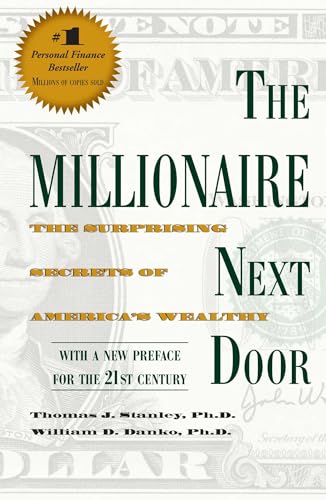
by Thomas J. Stanley & William D. Danko · 1996
The landmark study revealing that most American millionaires are ordinary people who live in ordinary houses and build wealth below their means.
Timeless lessons on wealth, greed, and happiness — exploring why smart people make irrational financial decisions and how behavior matters more than knowledge.
As an Amazon Associate I earn from qualifying purchases.