Finance 8 min read
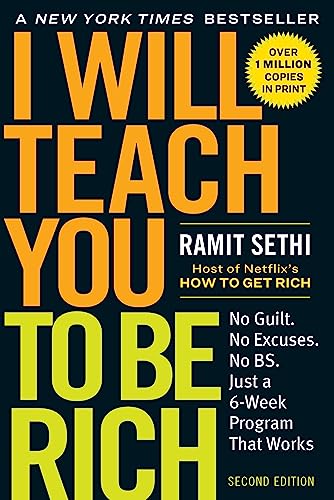
I Will Teach You to Be Rich
by Ramit Sethi · 2019
4.6
A no-guilt personal finance system for your 20s and 30s: automate savings and investing, spend on what you love, and cut everything else.

Amazon Associate link
by Vicki Robin and Joe Dominguez · 1992
Since 1992, Your Money or Your Life has argued that the real cost of anything isn’t its price tag but the hours of your life you traded to earn the money for it. Joe Dominguez, a self-taught Wall Street analyst who grew up partly on welfare in Spanish Harlem, retired at 31 by treating money as what he called life energy rather than as an end in itself; he teamed up with Vicki Robin in the 1970s to teach the nine-step program that became this book. Dominguez died of cancer in early 1997, and Robin herself was diagnosed with cancer in 2004 before retiring to a small Pacific Northwest island — only to be pulled back a dozen years later by the rise of the FIRE movement (Financial Independence, Retire Early), which she credits this book with helping to inspire long before the acronym existed. This edition, revised in 2018 with a new foreword by Mr. Money Mustache, keeps the original nine steps intact while updating the investment chapter for an index-fund era Dominguez never saw.
The book’s title comes straight from an old threat: if someone held a gun to your ribs and said “your money or your life,” most of us would hand over our wallets without hesitation — proof, Robin and Dominguez argue, that we already know our life is worth more than our money. Yet most people spend their working lives proving otherwise. The book profiles real readers caught in the trap: Rachel Z., a saleswoman working seventy-hour weeks who couldn’t shake the feeling that “something was missing”; Kristy, a tech worker who started taking anxiety medication after watching a coworker collapse at his desk from what the Japanese call karoshi, death by overwork; and Nicole, an advanced-practice nurse more than $100,000 in debt from a degree that took over eight years, sliding backward financially by 2011 even in a high-demand profession.
The authors call this “making a dying” instead of making a living, and back it with their own data: in a survey of more than 1,000 people across a range of incomes, average self-rated happiness came out between 2.6 and 2.8 on a 5-point scale, regardless of whether someone earned under $1,500 a month or over $6,000. Asked how much money would finally make them happy, respondents almost universally gave the same answer: 50 to 100 percent more than they currently had, no matter what that current amount was. Psychotherapist Douglas LaBier, cited in the book, found that 60 percent of the successful professionals in his own study suffered from depression, anxiety, or other work-related disorders.
The book’s central reframe treats money as something you trade the irreplaceable hours of your life for — what Robin and Dominguez call life energy. They walk through four levels most people confuse money with: the physical bills and coins, the psychological fears and habits attached to it, the cultural beliefs baked into it — the assumption that “more is better, growth is good” — and finally the life energy underneath all three. To make the stakes concrete, the book includes a table converting average remaining life expectancy into hours: a 40-year-old, statistically, has roughly 356,500 hours left, of which only about half remain once basic body maintenance like sleeping and eating is subtracted.
Once you accept that framing, the book argues, spending stops being a simple transaction and starts being an exchange of a finite, irreplaceable resource for a temporary object or experience — a shift in perception the 2018 revision compares to the choice offered in The Matrix between a comfortable illusion and an uncomfortable truth.
Step 2 of the program asks readers to calculate what their job actually pays once every job-related cost is subtracted: commuting time, work clothes, decompression time, vacations needed to recover, job-related illness. In the book’s own worked example, a nominal $25-an-hour job becomes a real $10 an hour once 30 extra hours a week of job-related time and $300 of job-related weekly expenses are factored in — meaning every dollar spent represents about six minutes of that person’s actual life energy.
Mark H., a construction project manager profiled in the book, ran the numbers on his own job and discovered nearly half of his income was being consumed by the simple cost of having the job in the first place; he and his wife restructured their finances so she could keep teaching special-needs kids while he retrained as a counselor, cutting their household stress even before their income fully recovered.
Robin and Dominguez chart what they call the fulfillment curve: early in life, each new possession genuinely does add to our sense of fulfillment — first necessities, then niceties, then outright luxuries — but the curve eventually peaks at a point they simply call enough, after which further spending buys progressively less satisfaction. Everything purchased beyond that peak becomes what they call clutter: possessions that cost money and attention without adding anything back. Their name for the specific psychological trap that keeps people buying past that point is the gazingus pin: any small, inexpensive item — earbuds, a particular flavor of chocolate, a certain kind of pen — that a person can’t walk past in a store without buying, almost on autopilot, only to forget about it the moment it joins a drawer full of identical impulse buys.
Once monthly income from savings and investments overtakes monthly living expenses, the authors call it the Crossover Point — the moment paid employment becomes fully optional rather than mandatory. Larry D., a corporate human resources employee, described the psychological effect of calculating his own projected Crossover Point as transformative: once he could see Financial Independence was actually on schedule, he stopped fearing layoffs entirely, went on to negotiate what he called some of the toughest settlements of his career, and came home telling his wife, “I’m bulletproof.” Sam and Donna, a couple who returned to Sam’s hometown in rural Kansas to build a passive-solar house with the help of sixty friends and Sam’s carpenter father, spent their days hauling trash and training as a nurse, respectively, while working toward self-sufficiency on their land; four years into the program, their investment income finally matched Sam’s trash-hauling income, and they reached their own Crossover Point.
Joe Dominguez grew up in Spanish Harlem, raised in part on welfare, never graduated from college, and by his own account simply stumbled into a job at a Wall Street firm — where he then taught himself the game well enough to develop some of the earliest technical-analysis tools in the early 1960s, while saving toward a single goal: retire by thirty. He made it at 31, in 1969. He and Robin teamed up in the 1970s, and the book they wrote together became a New York Times bestseller that spent five years on BusinessWeek’s bestseller list. Dominguez died of cancer in the first weeks of 1997; Robin continued the work until her own cancer diagnosis in 2004, after which she retired to a small Pacific Northwest island. It took a chance conversation with a group of financially anxious strangers, roughly a dozen years later, to pull her back in — and to introduce her to the FIRE movement, a community she describes this book as having helped inspire long before the acronym existed.
When Dominguez retired in 1969, US Treasury bonds paid over 6.5% with inflation under 3%, and rates eventually spiked to nearly 15% during the 1981 recession — a combination that made his simple “set it and forget it” Treasury bond strategy remarkably effective for the next three decades. As a reminder that no investment is risk-free, he used to give new graduates of the program an unusual gift: a yellowing czarist Russian bond, its coupons clipped faithfully until 1917, when the Russian Revolution made it worthless overnight.
The 2018 revision adds the strategy that’s replaced bonds for most of today’s FIRE community: low-cost index funds, popularized by Vanguard founder John Bogle. The book quotes Warren Buffett’s own verdict directly: “A low-cost fund is the most sensible equity investment for the great majority of investors.” It also includes a sobering ledger of market history as a counterweight to index-fund enthusiasm: the Great Depression wiped out 86% of the market’s value and took 27 years to recover; the 1987 crash erased 32% in three months and took four years to recover; and the 2007–2009 financial crisis cut the market roughly in half and took six years to recover.
The program builds toward what the authors call four FIs: Financial Intelligence (understanding what money actually is), Financial Integrity (aligning spending with your real values), Financial Independence (freedom from needing a paycheck), and Financial Interdependence (recognizing how much of your security still depends on other people and institutions). Robin acknowledges that people move through the program at different speeds, dividing them into turtles, who prioritize steady, moderate progress over any particular finish line, and hares, who — like Dominguez himself — set an aggressive target age and sprint for it. Among today’s FIRE community, she sees the same divide splitting further into recognizable types: Ninjas who optimize every system and hack every loyalty program, Minimalists who care more about clearing clutter than counting dollars, and DIYers who’d rather build, cook, and repair than buy.
“Enough is a fearless place. A trusting place. An honest and self-observant place.”
“Life energy is all we have. It is precious because it is limited and irretrievable.”
“A low-cost fund is the most sensible equity investment for the great majority of investors.”
“I’m bulletproof!”
Your Money or Your Life is best suited for anyone who suspects their spending and their actual values have quietly drifted apart, regardless of income level — the book explicitly rejects the idea that its advice only works for high earners, since its central exercises are about tracking and redirecting money you already have rather than earning more of it. It’s especially useful for the turtles Robin describes: people more interested in steady financial clarity and reduced stress than in a specific early-retirement date, since the nine-step program works as a complete framework even for someone with no interest in ever fully stopping paid work.
Readers already immersed in the FIRE community may find the investment chapter most useful as history — Dominguez’s original Treasury bond strategy reflected interest rates that no longer exist — but the book’s core psychological work, tracking your real hourly wage and locating your own “enough,” has stayed relevant since 1992 precisely because it was never really about which asset class to buy.
What is Your Money or Your Life about? It’s a nine-step program for changing your relationship with money by treating it as life energy — the hours of your life you trade to earn it — rather than as an end in itself. Vicki Robin and Joe Dominguez use that reframing to help readers calculate their real hourly wage, identify their own point of “enough,” and work toward Financial Independence.
What is the main lesson of Your Money or Your Life? That money is life energy: every purchase is really an exchange of a fixed number of your remaining hours for an object or experience. Once you calculate your real hourly wage — factoring in commuting, work clothes, and decompression time — many purchases stop looking like the good deals they first appeared to be.
Is Your Money or Your Life worth reading? Yes, particularly if you want the psychological and behavioral side of personal finance rather than a pure investment guide. It originated the idea of tracking your “real hourly wage,” and is widely credited with helping inspire the modern FIRE movement, decades before that acronym existed.
What is the Crossover Point in Your Money or Your Life? It’s the point at which monthly income from savings and investments exceeds monthly living expenses, at which point paid employment becomes fully optional. Robin and Dominguez treat it as the practical, calculable definition of Financial Independence, rather than a specific age or dollar amount.
Ready for the full experience?
Buy on Amazon →As an Amazon Associate I earn from qualifying purchases.
by Ramit Sethi · 2019
A no-guilt personal finance system for your 20s and 30s: automate savings and investing, spend on what you love, and cut everything else.

by Benjamin Graham · 1949
The foundational text of value investing: why Wall Street's formulas fail, and why margin of safety — not forecasting — protects your money.
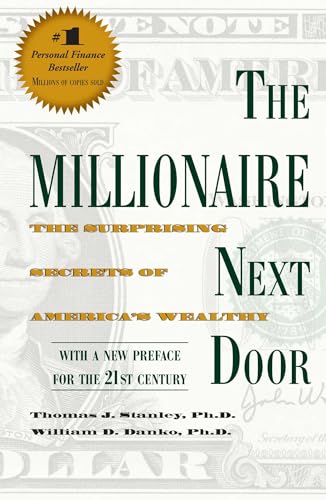
by Thomas J. Stanley & William D. Danko · 1996
The landmark study revealing that most American millionaires are ordinary people who live in ordinary houses and build wealth below their means.
A nine-step program built on one reframe: money is life energy, the hours you trade to earn it — and that changes how you see every purchase.
As an Amazon Associate I earn from qualifying purchases.