Finance 8 min read
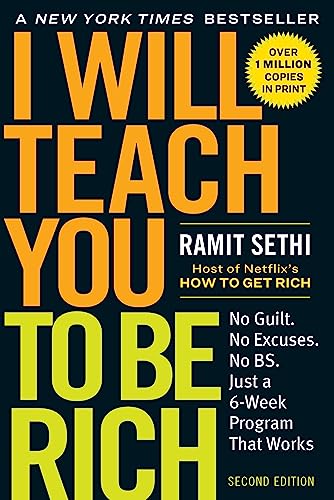
I Will Teach You to Be Rich
by Ramit Sethi · 2019
4.6
A no-guilt personal finance system for your 20s and 30s: automate savings and investing, spend on what you love, and cut everything else.

Amazon Associate link
by JL Collins · 2016
The Simple Path to Wealth grew out of letters JL Collins wrote to his teenage daughter, Jessica, after she told him she didn’t want to spend her life thinking about money. Those letters became a blog that, according to its foreword, grew from a following in the thousands to one in the hundreds of thousands; in 2016 it became this book, making the case for owning the entire US stock market through a single low-cost index fund rather than picking stocks or paying an advisor. This revised and expanded edition was worked on jointly with Jessica, now in her early thirties and closing in on her own financial independence, and updates the market data through 2024 — including the 2020 pandemic crash and the 2022 bear market — while keeping the original three rules unchanged: spend less than you earn, invest the surplus, avoid debt. The foreword, written by Pete Adeney (Mr. Money Mustache) and still signed “Colorado, June 2016,” appears carried over unchanged from the original edition.
Collins traces everything in the book back to three sentences he first wrote to Jessica: spend less than you earn, invest the surplus, avoid debt. He argues that complex investment products exist mainly to profit the people who sell them, and that the more complicated an investment sounds, the more likely that’s the case. Everything else in the book builds on those three original sentences, which he says have held up unchanged since he first wrote them.
Collins remembers getting his first credit card shortly after college, charging around $300, and being pleased to see a minimum payment of only $10 — until his older sister pointed out the 18% interest attached to the rest. He argues that debt is the biggest reason most people never build wealth, since it diverts income that could otherwise be invested. On “good debt,” he’s skeptical of all three common categories he covers: business loans, mortgages, and student loans. A mortgage, he argues, tempts people into buying more house than they need. On student loans, Collins notes that unlike other debt, they survive bankruptcy and can follow a borrower for life. Collins paid his own way through the University of Illinois from 1968 to 1972 on around $1,200 a year, including rent and food; by the time his daughter attended a public university, from 2010 to 2014, the cost was closer to $40,000 a year. His advice for anyone already in debt: list every debt, cut nonessential spending, and pay off the highest-interest balance first, rather than the smallest balance first as some popular strategies suggest.
Collins uses the term “F-You Money” — which he says he first encountered in James Clavell’s novel Noble House — to describe having enough saved that you can walk away from a job, situation, or person without financial fear. He states plainly that this was never about retirement for him; it was about having options. He first felt this at 25, after saving from his first professional job: when his employer refused his request for four months of unpaid leave to travel Europe, he resigned, and his boss then offered a shorter, six-week leave instead. Later, after losing his job shortly after the September 11 attacks and remaining unemployed for three years, the same savings let him tell his worried daughter, who had asked if they were poor, that they were “just fine” — because, in his own words, they had money working for them instead of a paycheck.
Collins states that across more than a century of Dow Jones history, through depressions, world wars, and multiple crashes, the market has always eventually recovered and gone on to new highs, though he’s clear this says nothing about what happens next week or next year. He calls market timing a fool’s errand and states that it isn’t possible, regardless of any analyst’s claims otherwise. He illustrates this with his own experience of Black Monday in 1987, when the market fell more than 20% in a single day: he held on for three or four months, then sold near the bottom, and took about a year to get back in — by which point the market had already passed its pre-crash high. He describes it as a lesson in not yet being tough enough, one that later helped him stay invested through the 2008 crash.
Collins calls the 1929 crash and the Depression that followed the Big Ugly Event: a roughly 90% loss of value that, for someone who invested exactly at the peak, took decades to recover. He notes that an investor who bought a few years before the peak, or who kept adding money as prices fell, recovered much sooner than the worst-case number suggests, and that anyone still working and accumulating during a crash is effectively buying shares at a discount. He also discusses hyperinflation as the opposite risk, citing 1920s Germany and Zimbabwe as examples of currencies collapsing, and treats stocks as a hedge against this because the businesses behind them can raise prices along with inflation.
The fund Collins returns to throughout the book, Vanguard’s Total Stock Market Index Fund (VTSAX), holds a small piece of nearly every publicly traded US company. He calls this quality “self-cleansing” — a term he says he coined — because failing companies eventually drop out of the index while winners can keep growing without limit. Collins says he didn’t always believe in indexing; he describes years spent trying to beat the market, including a loss of $50,000 in a speculative gold-mining penny stock. He credits Jack Bogle, who founded Vanguard, with building a company whose ownership structure ties its own interests to those of its investors, and with demonstrating over decades that almost no professional stock-picker consistently beats a simple index fund.
Collins organizes his advice around two stages rather than age: the wealth accumulation stage, while you’re earning and saving, and the wealth preservation stage, once you’re living off your investments. During accumulation, his advice is to put everything into VTSAX and keep adding to it. During preservation, he introduces a second fund, Vanguard Total Bond Market Index Fund (VBTLX), to reduce volatility. His own household holds roughly 75% VTSAX, 20% VBTLX, and 5% cash, rebalanced about once a year. He also recommends target retirement funds for readers who don’t want to manage even two funds, since they combine stocks and bonds and automatically shift toward a more conservative mix as a chosen retirement date approaches.
Collins describes accounts like 401(k)s, IRAs, and Roth versions of each as buckets, not investments themselves — the fund matters more than which bucket holds it, though the bucket affects when and how tax is owed. His general order of priority: contribute enough to any employer plan to get the full matching contribution, then fund a Roth account while income and tax bracket are still low, then shift toward tax-deductible accounts as income rises. He recommends health savings accounts (HSAs) for anyone on a high-deductible health plan, since contributions are deductible, the account grows tax-free, and withdrawals for medical expenses are never taxed — meaning someone who pays medical bills out of pocket and keeps the receipts can let the account grow for decades and reimburse themselves later. He notes that none of these accounts eliminate taxes owed; tax-deferred accounts only delay it, and the government eventually requires withdrawals, and its share of them.
Collins includes two real reader stories from his blog. Dave, 26 and debt-free with a steady job, wrote in with money his grandparents had been saving for him since the mid-1990s, asking how to consolidate it out of twelve mutual funds and into VTSAX, and how to prioritize his 403(b) against his own IRA. Collins’s answer works through the account-priority order described in the previous lesson. Tom’s story is different: a former Marine officer who went through multiple career changes, two divorces, a retirement account reduced by roughly $80,000 under a money manager during the early-2000s downturn, and eventually a home foreclosure and bankruptcy filing in his sixties. Collins notes that Tom, now living on a small pension, a veterans’ benefit, Social Security, and part-time work, describes his life as good again, crediting friends, family, and attitude rather than any specific amount of money.
Collins argues that the problem with financial advisors is structural: however they’re paid — commission, a percentage of assets under management, or an hourly rate — their incentives don’t fully align with the client’s. He works through the math of a 2% annual fee: a $100,000 account earning the market’s 12.2% long-run historical return grows to about $999,671 over twenty years; the same account with a 2% fee taken out grows to about $697,641 — a difference of $302,030. He cites Bernie Madoff as an extreme example, noting that many of Madoff’s victims were themselves financial professionals.
Collins argues against dollar cost averaging a lump sum into the market gradually, since stocks have historically risen in 41 of the last 50 years — about 82% of the time — meaning that spreading out a purchase usually means paying more, not less. He also describes, step by step, how to become a market “guru”: predict a crash, repeat the prediction until it happens to come true, then publicize it before anyone remembers the earlier misses. He walks through the mechanics of a real stock-tip scam he encountered: a stranger mails predictions to a large list of people, continuing to contact only the smaller group who received the correct call each time, until a handful of recipients have seen six correct predictions in a row and are ready to hand over money. Collins’s point, made to a friend’s widow he had tried to warn, is that everyone is vulnerable to this, and that believing you’re too smart to be conned is itself a risk.
The “4% rule” comes from a 1994 paper by William Bengen, a financial planner with a background in aeronautics, who suggested 4.2% and called it conservative. The number most people cite today comes from a later study by three Trinity University finance professors, who found that a 50/50 stock-bond portfolio, with withdrawals adjusted for inflation each year, stayed intact for 30 years in 96% of the historical starting years tested, failing only for those who started withdrawing in 1965 or 1966. In many of those surviving cases, the portfolio grew larger despite the withdrawals. Collins notes that fees reduce this success rate substantially, and says he doesn’t track his own withdrawal rate precisely, adjusting his spending each year based on his circumstances rather than following a fixed percentage.
Collins describes Social Security as designed in the 1930s, when relatively few people lived long past the age it let them start collecting; with people now living longer, the program pays out more than it collects, and its reserve fund is on track to run out within roughly the next decade if nothing changes. His own planning assumes the benefit could shrink, though he collects it himself. On giving, he describes winning a charity-auction dinner for his daughter’s school teachers as one of his most satisfying purchases, and later setting up a fund through the Vanguard Charitable Endowment Program to give in a tax-efficient way to a small number of causes. The book closes on the idea that there’s no risk-free choice: cash loses purchasing power to inflation every year it sits still, so the real question isn’t whether to take on risk but which kind.
“Complex investment instruments exist only to profit those who create and sell them.”
“Put all your eggs in one basket and forget about it.”
“I’ve been in this business 61 years and I can’t do it.”
“Toughen up, cupcake, and cure your bad behavior.”
The Simple Path to Wealth is written for people who want one clear answer to what to do with their money, rather than a survey of options. It suits younger readers just starting to save, since the accumulation-phase advice is a single fund with little ongoing effort.
It’s a less direct fit for readers looking for coverage of real estate, entrepreneurship, or active stock-picking as wealth-building strategies, since Collins says plainly he has no interest in any of the three. International readers should expect the tax-account chapters to be US-specific, as Collins says himself, though the general principle — use whatever tax-advantaged accounts your own country offers — still applies.
What is The Simple Path to Wealth about? It’s JL Collins’s case for building wealth through simplicity: spend less than you earn, invest the surplus in a single low-cost total stock market index fund, and avoid debt. The book grew out of letters Collins wrote to his teenage daughter and out of the blog that followed, which the book’s own foreword describes growing from a few thousand readers to hundreds of thousands.
What is the main lesson of The Simple Path to Wealth? That owning the entire stock market through one low-cost index fund — Collins recommends Vanguard’s VTSAX — outperforms picking individual stocks or paying professionals to do it for you, and that the biggest threat to building wealth isn’t market volatility but panic-selling during a crash.
Is The Simple Path to Wealth worth reading? Yes, particularly for anyone who wants a simple, decisive answer rather than a survey of investment options. According to its own author bio, the book has sold over a million copies across twenty languages, and this revised edition updates its market data through 2024 while keeping the original philosophy intact.
What is VTSAX, and why does JL Collins recommend it? VTSAX is Vanguard’s Total Stock Market Index Fund, which holds a small piece of nearly every publicly traded US company. Collins recommends it because its “self-cleansing” structure lets failing companies drop out and winners grow without limit, at a cost far lower than actively managed alternatives.
Ready for the full experience?
Buy on Amazon →As an Amazon Associate I earn from qualifying purchases.
by Ramit Sethi · 2019
A no-guilt personal finance system for your 20s and 30s: automate savings and investing, spend on what you love, and cut everything else.

by Benjamin Graham · 1949
The foundational text of value investing: why Wall Street's formulas fail, and why margin of safety — not forecasting — protects your money.
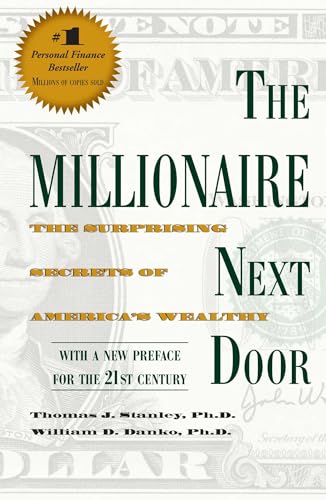
by Thomas J. Stanley & William D. Danko · 1996
The landmark study revealing that most American millionaires are ordinary people who live in ordinary houses and build wealth below their means.
A finance blogger's letters to his teenage daughter, built into a case for owning the whole stock market through one low-cost index fund.
As an Amazon Associate I earn from qualifying purchases.